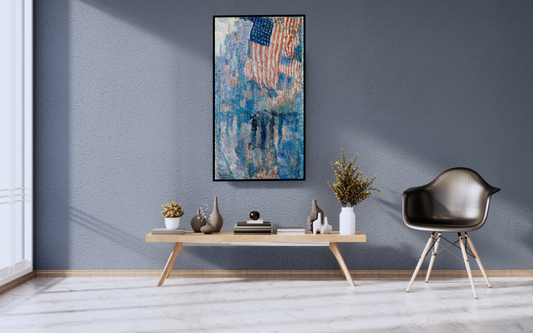
Collection: White House; Washington

The White House is both the official residence and workplace of the President of the United States and a living museum of American history. Selected by President George Washington in 1791, its cornerstone was laid a year later. Since President John Adams first moved into the unfinished residence in 1800, every subsequent U.S. president has called it home, making the White House a place where the nation’s history continues to unfold.
Construction, Destruction, and Rebirth
The original design for the President’s House was submitted by Irish-born architect James Hoban. After eight years of construction, John and Abigail Adams became its first residents. The building faced its greatest trial during the War of 1812 when it was set on fire by the British. The task of rebuilding the gutted structure was given to its original architect, James Hoban. By 1817, the residence was habitable once again, allowing President James Monroe to move in and re-establish it as the home of the nation’s leader.
A Century of Growth and Change
Throughout the 19th century, the White House continued to evolve. The South Portico was constructed during the Monroe administration, and Andrew Jackson oversaw the addition of the North Portico in 1829. A more significant transformation occurred in 1902 when President Theodore Roosevelt began a major renovation planned by the architectural firm McKim, Mead and White. This project modernized the building by relocating the president’s offices from the residence to a newly constructed building on the grounds, which would become what is known today as the West Wing. It was also during this era, in 1901, that Roosevelt officially gave the White House its current name.
The Truman Reconstruction
Less than fifty years after the Roosevelt renovation, the mansion was found to be structurally unsound. In a drastic but necessary measure, President Harry S. Truman began a complete reconstruction of the building between 1948 and 1952. Under the guidance of architect Lorenzo Winslow, the entire interior of the White House was dismantled, leaving only the original outer walls standing. The structure was then rebuilt from the inside out, preserving its historic shell while ensuring its survival for future generations.
A Museum in the Making: The White House Collection
The fine art collection at the White House has grown over time from an informal assembly into a professional museum collection. Initially, it consisted mostly of presidential portraits commissioned by Congress or donated by descendants. The turning point came during the administration of President John F. Kennedy, when the first official White House curator was hired and a formal protocol was developed for maintaining and adding to the collection. Since that time, it has grown exponentially under the guidance of a professional curatorial staff and now includes more than 500 works of art, each selected for its historical and cultural significance to the United States.
-
The Avenue in the Rain
Regular price From $276.00 USDRegular price