Collection: Hermitage Museum; Saint Petersburg
 Founded in 1764 by Catherine the Great, the Hermitage Museum in St. Petersburg is one of the largest and most prestigious art museums in the world. Originally established as a private court museum adjoining the magnificent Winter Palace, it has since evolved into a vast public institution. Today, its collection comprises nearly three million items, spanning from the Stone Age to the present, housed within a grand complex of five interconnected buildings.
From Imperial Gallery to Public Museum
The Hermitage began as a private gallery for the immense art collection amassed by Empress Catherine the Great. For decades, it remained an exclusive treasure of the Russian court. This changed under Tsar Nicholas I, who commissioned a major reconstruction of the museum complex between 1840 and 1852. Following this renovation, the Hermitage was officially opened to the public for the first time, allowing the Russian people and the world to experience the imperial collections.
A Tumultuous 20th Century
The 20th century brought profound changes to the Hermitage. Following the October Revolution of 1917, the entire imperial collection became public property. In the 1920s, the museum’s holdings were greatly expanded with art requisitioned from private collections. However, during the push for rapid industrialization from 1930 to 1934, the Soviet government sold off some of the museum’s masterpieces to fund the purchase of industrial machinery from the West. In the years immediately following World War II, the Hermitage once again grew, substantially expanding its collection of late 19th and early 20th-century European art.
A Universal Collection
The Hermitage’s holdings are encyclopedic in their scope. It is home to one of the world’s richest collections of Western European painting since the Middle Ages, with numerous masterpieces by Italian Renaissance artists and Baroque painters from the Netherlands, Flanders, and France. The museum also features a comprehensive representation of Russian art throughout history and boasts extensive holdings of Asian art, with a particularly noteworthy collection of art from Central Asia.
The Hermitage Abroad
In the 21st century, the Hermitage has embarked on a larger effort to showcase its treasures to a global audience. This initiative has led to the establishment of several satellite museums at home and abroad. The largest of these international outposts, the Hermitage Amsterdam, opened in the Netherlands in 2009, bringing the renowned collections of the St. Petersburg institution to a new public.
-
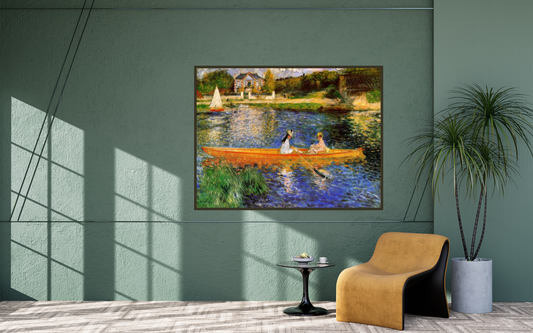
The Seine at Asnieres
Regular price From $276.00 USDRegular price