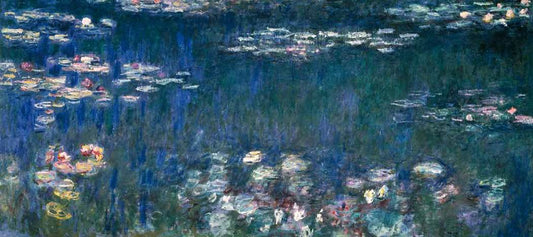
Collection: Tuileries Orangerie; Paris

Located in the heart of Paris in the Tuileries Garden, the Musée de l’Orangerie is a unique art museum celebrated for its two remarkable and distinct collections. It serves as the bespoke sanctuary for Claude Monet’s final, monumental masterpiece, the Nymphéas (Water Lilies), while also housing the exceptional Jean Walter and Paul Guillaume collection of early 20th-century masters, from Renoir and Cézanne to Picasso and Modigliani.
From Royal Orangery to Public Hall
The building was not originally intended for art. Constructed in 1852 according to plans by architect Auguste Bourgeois, it was built as an orangery to shelter the orange trees of the Tuileries Palace garden during the winter. Designed like a greenhouse, its long glass façade faces south to capture sunlight. After the fall of the French Empire in 1870, the building became state property and was used for a variety of public events, including horticultural shows, banquets, and even dog shows, until its artistic destiny was realized.
Monet’s Grand Design: The Nymphéas
The Orangerie’s identity was forever changed after World War I. In 1921, at the suggestion of French Prime Minister Georges Clemenceau, the state designated the building to house the grand cycle of Nymphéas paintings, which Claude Monet was then working on as a gift to the nation. Monet himself was deeply involved in the architectural project, collaborating with architect Camille Lefèvre to design the perfect space. He created eight immense panels, totaling 91 meters in length, to be installed in two adjoining oval rooms that form the sign of infinity. He specifically requested that the rooms be lit by natural light from the ceiling, creating an immersive, serene environment that would allow the visitor to be completely enveloped by his vision.
The Walter and Guillaume Collection
The museum’s second major identity was forged through the acquisition of the Jean Walter and Paul Guillaume collection. Assembled by the visionary art dealer Paul Guillaume, the collection was donated to the state by his widow, Domenica Walter, in the 1950s and 60s. To accommodate these 146 new works, the Orangerie underwent a major renovation in the 1960s, during which two full floors of galleries were constructed above the Nymphéas rooms. The Orangerie officially became an independent national museum in 1984, dedicated to its two prestigious collections.
A Return to Light: The Modern Museum
Between 2000 and 2006, the museum underwent its most recent and definitive transformation. In a bold architectural move, the two gallery floors added in the 1960s were completely removed. This project’s primary goal was to restore the natural, zenithal light to the Nymphéas rooms, finally fulfilling Claude Monet’s original design and intent. New, modern gallery spaces were created in the building’s basement to house the Jean Walter and Paul Guillaume collection. Reopening in 2006, the Musée de l’Orangerie now presents a fluid and coherent visitor experience, allowing for a clear dialogue between Monet’s ultimate Impressionist statement and the masterpieces of the early 20th-century School of Paris.
-
Water Lilies
Regular price From $1,120.00 USDRegular price